The New Kingdom & Ramesses II
The New Kingdom (c. 1550–1070 BCE) was Egypt at its greatest — an empire stretching from Nubia to Syria, ruled from Thebes, and filled with the temples and tombs we still visit today. Its most famous king, Ramesses II, reigned for 66 years, fought the largest chariot battle in history, and built more monuments than any pharaoh before or after him.
In short
The New Kingdom (c. 1550–1070 BCE) began when Ahmose I drove the Hyksos out of Egypt and turned the country into an empire reaching from Nubia to Syria. Its peak came under Ramesses II (reigned c. 1279–1213 BCE), whose 66-year reign, Battle of Kadesh (c. 1274 BCE), and vast building programme — including Abu Simbel — made him Egypt's most famous pharaoh.
From liberation to empire
The New Kingdom began in war. The Theban kings Kamose and then Ahmose I fought the Hyksos out of the Delta, and around 1550 BCE Ahmose founded the 18th Dynasty. The Egyptians had learned from their occupiers: they now had the chariot and the composite bow, and they used them to build something Egypt had never been before — an empire. Egyptian armies marched into Nubia as far as the Fourth Cataract and through the Levant to the Euphrates. Gold from Nubia, timber from Lebanon, and tribute from conquered cities flowed into Thebes, and the god Amun of Thebes became the king of the gods.
The 18th Dynasty produced the most famous names in Egyptian history. Hatshepsut, who ruled as a female king around 1479–1458 BCE, sent a trading expedition to the land of Punt and built a great temple at Deir el-Bahari. Thutmose III, the great military campaigner, fought seventeen campaigns in the Levant. Amenhotep III built on a scale no king had matched. Then Akhenaten tried to change everything: he moved the capital to a new city, Amarna, and ordered Egypt to worship one god, the Aten, the disc of the sun. After his death, the old gods were restored — by the boy king Tutankhamun, among others — and Amarna was abandoned.
Ramesses the Great
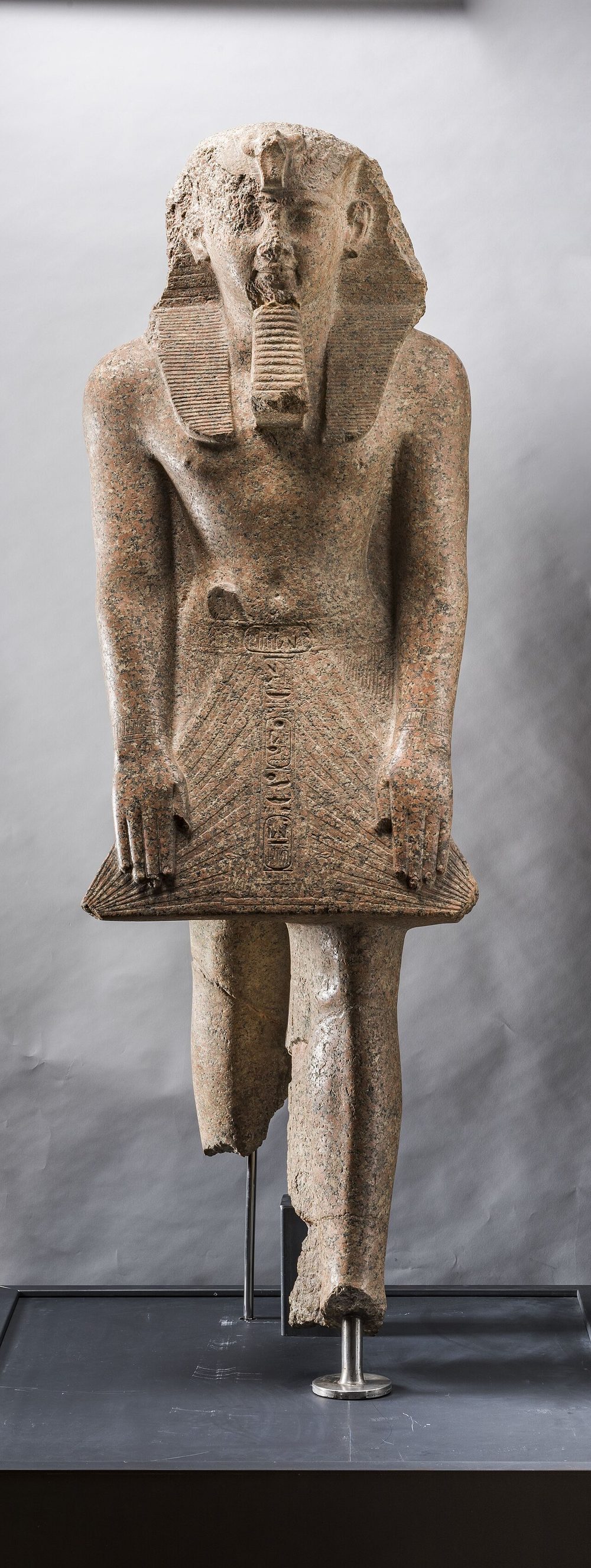
Ramesses II, third king of the 19th Dynasty, came to the throne around 1279 BCE, probably in his early twenties, and ruled for 66 years — the longest reign of the New Kingdom and one of the longest in all Egyptian history. He outlived most of his own children, including twelve crown princes. He built more temples and statues than any pharaoh before or after him, and he put his name on monuments built by earlier kings too. His throne name, Usermaatre, became "Ozymandias" in Greek, and inspired Shelley's poem about a ruined statue in the desert.
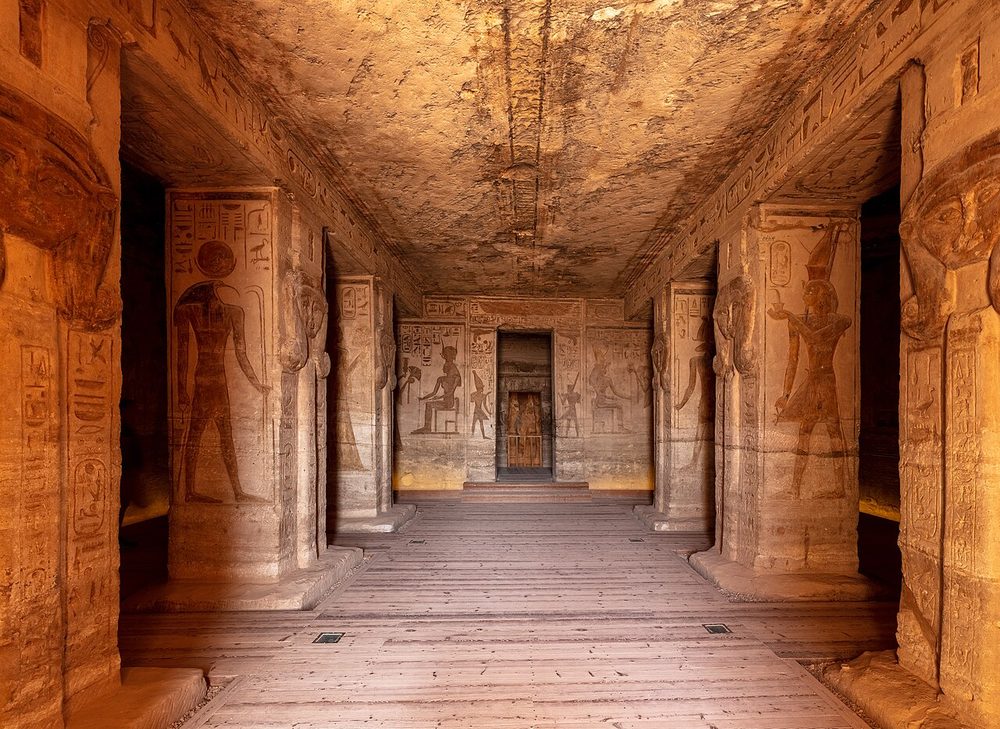
Ramesses built a new capital, Pi-Ramesses, in the eastern Delta, and filled Egypt and Nubia with monuments. The greatest of them are the two temples at Abu Simbel in Nubia, cut into the rock, with four colossal statues of the king, each about 20 metres tall, seated at the entrance. Twice a year, the rising sun shines down the corridor of the Great Temple and lights the statues inside. In the 1960s, UNESCO moved the whole temples, stone by stone, to higher ground to save them from the rising waters of Lake Nasser behind the Aswan High Dam — one of the great engineering rescues of the twentieth century.
The Battle of Kadesh
Ramesses's most famous campaign was against the Hittites, the other great power of the Bronze Age, for control of Syria. In his fifth year as king, around 1274 BCE, he marched four divisions — named for the gods Amun, Ra, Ptah, and Seth — towards the city of Kadesh on the Orontes River, in modern Syria. Hittite king Muwatalli II hid a large chariot force and tricked the Egyptians into thinking his army was far away. Hittite chariots smashed into the marching Egyptian division of Ra and burst into the Egyptian camp while Ramesses was cut off with only his guard.
By his own account — carved on the walls of at least five temples — Ramesses charged the Hittite chariots almost alone, called on the god Amun, and turned the battle. Reinforcements arrived, and the Egyptians held the field. In truth the battle was a draw: Kadesh stayed in Hittite hands, and the Egyptians withdrew. But Ramesses turned it into the greatest propaganda triumph of his reign. About sixteen years later, around 1259 BCE, Egypt and the Hittites signed a peace treaty — the oldest surviving international peace treaty, a copy of which hangs in the United Nations building in New York.
Thebes, city of temples
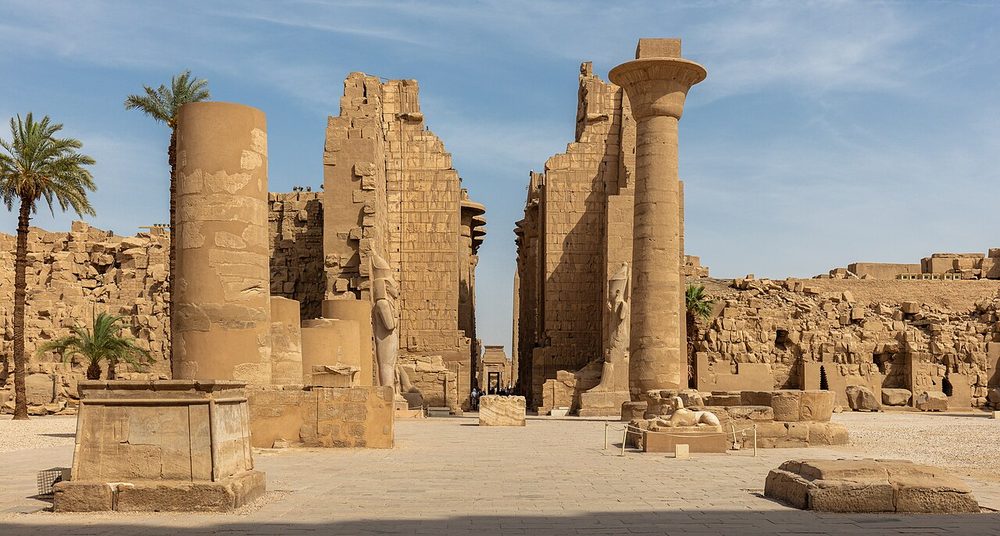
The New Kingdom made Thebes — modern Luxor — the greatest religious city of the ancient world. On the east bank stood the temple of Karnak, the largest temple complex ever built, added to by king after king for 2,000 years, with its forest of columns in the Hypostyle Hall; and the temple of Luxor, joined to Karnak by an avenue of sphinxes. On the west bank lay the city of the dead: the Valley of the Kings, where the pharaohs were buried in hidden rock-cut tombs, and the great mortuary temples of Hatshepsut, Ramesses II, and others.
The New Kingdom ended around 1070 BCE, weakened by the Sea Peoples' attacks, the Late Bronze Age collapse, and the rising power of the priests of Amun in Thebes. Egypt split again, into the Third Intermediate Period. But the empire's monuments — Karnak, Luxor, Abu Simbel, the Valley of the Kings — still define what the world pictures when it thinks of ancient Egypt.
Sources: Wikipedia — Ramesses II, Britannica — When did Ramses II rule Egypt?, Wikipedia — New Kingdom of Egypt Checked 27 November 2026.