Cleopatra & the Ptolemies

Cleopatra is the most famous Egyptian queen who ever lived — and she was not Egyptian at all. She was the last ruler of the Ptolemies, a family of Macedonian Greek kings who ruled Egypt for nearly 300 years after Alexander the Great. She spoke Egyptian, presented herself as an Egyptian goddess, and fought to keep her kingdom free of Rome. She lost — and Egypt became a Roman province.
In short
Cleopatra VII (reigned 51–30 BCE) was the last active pharaoh of Egypt, a member of the Macedonian Greek Ptolemaic dynasty that had ruled since Alexander the Great's death in 323 BCE. She was the only Ptolemaic ruler to learn Egyptian. After her defeat by Octavian at the Battle of Actium in 31 BCE, she died in 30 BCE and Egypt became a Roman province.
Greek kings of Egypt
When Alexander the Great died in 323 BCE, his empire was divided among his generals. Egypt went to Ptolemy I Soter, a Macedonian general and companion of Alexander, who founded the Ptolemaic dynasty. The Ptolemies ruled from a new capital, Alexandria, a city Alexander had founded on the Mediterranean coast in 331 BCE. Alexandria became the greatest city of the ancient world after Rome: home to the Great Library, the greatest collection of books ever assembled, and the Pharos lighthouse, one of the Seven Wonders of the Ancient World.
The Ptolemies kept themselves apart. For nearly 300 years they spoke Greek, married within the family, and presented themselves as Greek kings — the only Ptolemaic ruler who learned Egyptian was Cleopatra. The first three Ptolemies ruled well and made Egypt rich; their successors ruled badly, and the kingdom weakened as Rome grew stronger in the Mediterranean.
Cleopatra's rise
Cleopatra VII was born in 69 BCE, the daughter of Ptolemy XII. When her father died in 51 BCE, she became queen, ruling first with her brother Ptolemy XIII, then with her younger brother Ptolemy XIV, and finally with her son Caesarion. She was a capable ruler in difficult times: Egypt faced bad harvests, debt, and pressure from Rome. She spoke many languages — Egyptian, Greek, and several others — and she presented herself as the goddess Isis, the mother of Egypt, in a way no Ptolemy before her had done.
Her alliances with Rome's most powerful men were political as much as personal. With Julius Caesar, who came to Egypt in 48 BCE and restored her to the throne after her brother drove her out, she had a son, Caesarion. With Mark Antony, she built an alliance that returned old Ptolemaic lands in the east to her rule, and had three children. Both alliances were meant to protect Egypt from being swallowed by Rome — and both made her the enemy of the men who eventually ruled Rome.
Actium and the end
The end came at the Battle of Actium, on 2 September 31 BCE. Octavian — the future emperor Augustus — defeated the combined fleet of Antony and Cleopatra off the coast of Greece. The couple fled to Alexandria, and Octavian's forces invaded Egypt the next year. Antony died by his own hand, and Cleopatra, on 10 or 12 August 30 BCE, also took her own life — according to the famous story, by the bite of an asp, though the real cause is not certain. She was 39 years old.
With her death, Egypt became a province of the Roman Empire, and the Hellenistic age — the 300 years since Alexander's death — came to an end. Octavian had Caesarion killed, ending the Ptolemaic line. Alexandria stayed a great city under Rome, but Egypt would never again be ruled by a pharaoh.
The legend
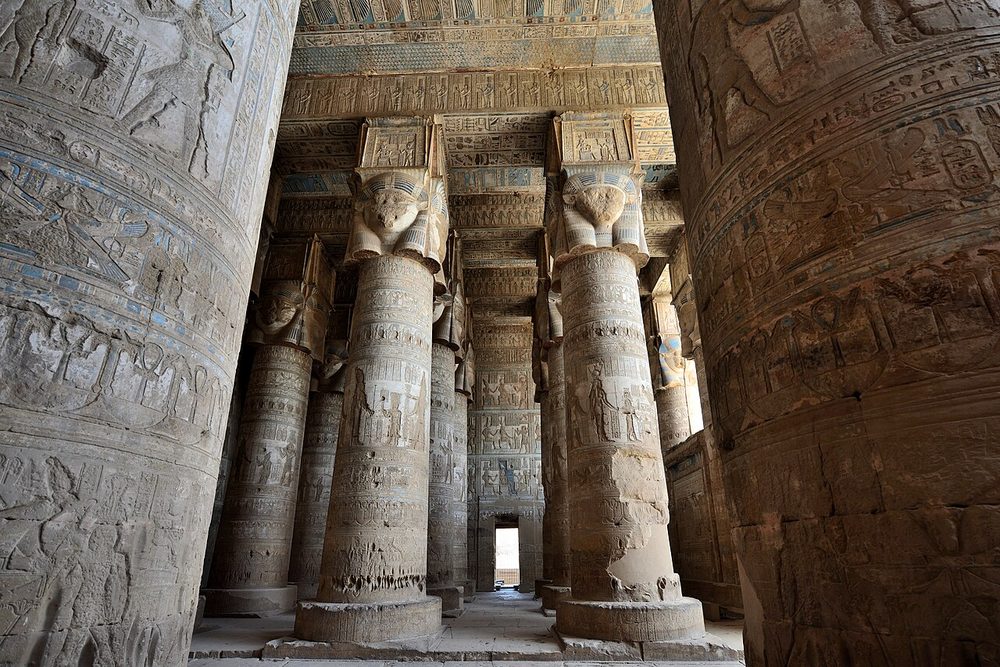
Cleopatra's reputation was written by her enemies. Roman writers painted her as a seductress who destroyed great men; later centuries turned her into a romantic heroine in plays, operas, and films. The real Cleopatra was something more interesting: a shrewd, multilingual ruler who held a weakening kingdom together for 21 years, reformed its coinage and administration, and came closer than anyone to keeping Egypt independent in the age of Rome. Her image survives on coins minted in her own lifetime — a strong-nosed, determined face, very different from the Hollywood version — and in the temple carvings at Dendera, where she stands beside her son as a pharaoh of Egypt.
Sources: Wikipedia — Cleopatra, Britannica — Cleopatra, World History Encyclopedia — Cleopatra VII Checked 27 November 2026.